Friday, October 29, 2010

Experiment.

A few of my fellow Visual Culture classmates and I are thinking of mounting a small exhibition this May. We are all doing museum/gallery/preservation/object-based theses, and they would dovetail nicely in this exhibition. We have no theme, no set plan; we will know better what we're doing once I survey the collection in a week or two.

Jimena is thinking about making exhibits sustainable (not as in, "we made these jeans out of organic cotton" but as in, "we only use florescent lighting and printed our programs with handmade potato stamps on recycled paper bags"). Lucie is looking at exhibition planning history and exploring its future. Marcella is doing her thesis on fashion copyright law, perhaps not the most apropos this specific exhibition, but has tons of awesome museum administration and research experience that will be invaluable.

I've been thinking a lot about the practicality of mounting whatever pieces we choose. So tonight I decided to try to make a seriously DIY mannequin out of recycled/found materials (gaff tape "inherited" from a show I worked on, a tshirt I've owned forever, newspaper from the paper recycling at work, a padded hanger donated to the cause by my boss) to see if it's a viable choice for this show.

It isn't.

Below, please find pictures of my experiment.
Bodies are so different, unsurprisingly. Especially with more than 100 years difference.

The finished product. Was so engrossed in taping myself into this shirt that I forgot to take a picture of the process.


Stands on its own. Very classical sculpture, especially with the uncut sleeve left on like a cut off arm.


The model, the dress.


Foreboding measurements.


Aaaaaand......mannequin fail. It won't even come close, even with newspaper being squished out and the bodice taken way in. It's a job for another woman. Any tiny friends want to volunteer?

Saturday, October 23, 2010

"As Elizabeth Lawrence often said, 'To understand a designer, you have to get into his mind; to understand a dress, you must allow it to tell you what it is all about.'"
--From A Dressmaker Extraordinaire by Betty Kirke.

Also, a very interesting article here. O! The things to learn at the Costume Institute.

Kirke wrote Madeleine Vionnet, full of beautiful photos, observations and, brilliantly, PATTERNS of MV's work. This is the kind of work I want to do, and the challenge of taking patterns from clothing that was not only cut on the bias to begin with but also had been worn, conforming to bodies and shifting shapes over the decades is daunting, but exciting. I feel the same about Marie Anna's clothing; so many different little pieces, and how do you figure the sleeves? I suppose you look at contemporary patterns. Or maybe find Janet Arnold's notebooks? Look for the grain, the grain! At least I'm not dealing with crepe or jersey. And anyways, that's just a fantasy for now....

But the above quotation best describes where I am in my thesis right now. I can read all I want about the middle class and Simmel's contemporary ideas about fashion, but I just need to look at these garments. I'm going home as soon as I can to start that very basic task of cataloging and choosing pieces....so exciting!

Tuesday, October 12, 2010

Refine the thesis.


Between schoolwork, working six days a week at New York Theatre Workshop (four-show weekends!) and two days of an internship at the Costume Institute at the Metropolitan Museum of Art, I haven't had much time to write here. A lot of work I have been doing with this collection is more theoretical, soaking up information and practices from the CI, reading social theory (my man Veblen) and only gazing at our beautiful pieces from afar.

There is no formal thesis title yet, nor a good solid question to answer with 100 pages of original writing, but there is a concept. I have this incredible collection of things, and I was somehow mentally stuck on attempting to account for each object, and how I would figure out whose items were whose, etc etc. Instead, my advisor sagely suggested I do a sort of "greatest hits" thesis, an examination of exemplary or important pieces (as subjectively chosen by the author), and what they say about the visual identity of a(n upper?) middle class woman in Boston at the turn of the century.

I haven't had a moment to spare to get back to Connecticut and evaluate the collection as a whole, but am very much looking forward to setting aside a whole day to take full stock of what we have. Making lists, perhaps taking measurements, maybe even assigning some sort of numbering system? Definitely taking many photos. Our own little museum! But then the most exciting part, choosing which items to highlight in this thesis.

I have some preliminary choices: a post-maternity dress that I will start to describe later in this post, at least one wool walking suit, something in cotton, perhaps a parasol and hat? And do I include the mourning hat of her husband? Or is that more of an exhibition choice than a thesis choice? We shall see.

So, on to one of the beautiful pieces I have here in Brooklyn. Before Mimi Maternity and A Pea in the Pod, there were.....mothers. Or mothers-in-law....or perhaps sisters or friends? Someone to make you something to wear after the rigors of pregnancy.

The post-maternity nature of this dress is as yet only a guess on my part, for a few reasons.

Although the sleeve shape,

collar style,


and extensively pieced back body place this piece fashionably in the middle of the 1890s,


the shapelessness of the front in a substantially fitted decade leads me to believe this is a nursing gown.

There is an inner lining with as many darts as and similar piecing to those of many formal, boned bodices made for public wear I've examined,


but in this garment the lining is a simple muslin, and is not even turned under at the bottom edge.


There is no boning; this lining is not, as with the public bodices, added to create an understructure for the outside layer, since on this garment the front is extensively cartridge pleated.


In this case, it is to keep the carefully pieced backside tight to the body, in a flattering and fashionable manner. My theory is, then, that the free-flowing front is to hide any body "imperfections" that might have resulted from pregnancy and birth. Although the lining has many shaping darts, I am unsure whether a corset was worn underneath this item. With the presentist prejudices of a modern woman, I like to imagine it was worn without, the lining acting as Interim Corset, letting the body have time to heal and facilitate breastfeeding.

Another presentist reading of this garment would use the side opening as evidence of a post-maternity breastfeeding consideration, but many non-maternity garments from this decade opened similarly. However, the plastron fronts of the public bodices were better integrated, so perhaps there is some small arguing point. The lack of any closure along that side-front opening of this dress allows the lining to become visible, which argues the use of this garment outside the house.

Finally, she could have been breastfeeding in 1894-5, as her son Frederick Adam Mock was born in August 1893.

This beautiful piece is made of cotton, with a muslin lining, and lace around the collar that I assume is also cotton. The buttons are most likely of bone, or maybe wood, although they don't feel like wood. I understand that plastics were not in use yet, although that would have been my first guess from observation. There are metal hooks and eyes attached to the outer fabric to keep the piece together, although few in number. As with many garments in this decade, long, hidden seams are machine stitched, and finishing is done by hand.

More research to be done on contemporary maternity dresses....and any comments and questions are welcome, as always!

Sunday, August 22, 2010

What about....

if I recreate three dresses from, say, 1890-1910? Or three somethings?

Saturday, August 7, 2010

ONE box.

Not to make anyone jealous.....
But I just looked through ONE box up in the attic and found:
•two black silk parasols, one with a creepy ivory handle depicting two hands and one with a beautifully carved ebony handle
•a child's black dress, of a yet-unidentified black patterned fabric, but distinctly from the 1890s, WITH a piece of the fabric it was made from (!!)
•eight or nine small handworked purses
•a few petticoats

and so many other things I couldn't bear to look at because it was a little toasty up there.

I recently moved from the Upper West Side to Brooklyn, and in the move decided it was best to return the very wintery wool suits back to Mystic, and exchange them for more summery attire.

What I ended up with, from that box, were just two items: a gauzy white dress that must be c.1910 and a decidedly 1890s....housedress? nightgown? maternity something-or-other? In my preliminary perusal I was fascinated to find that there was still an understructure of sorts. I don't think I got to explain much of my examination of the wool bodices to you (perhaps later? I'm a little dizzy with the possibilities, and am still using this blog as a place to think out loud more than present particular research) The cotton linings in the wool bodices attached by hook and eye to themselves first at the center front, forming a light boned understructure for the outer wool layer to conform to. This new blue-striped garment is intentionally shapeless--curiously, and to be explored later, the center front neckline is raw gathering...is it meant to be covered by a detachable collar of some sort?--but still has a rough muslin lining with BONE buttons down the front. Is this to keep the outer lengths of fabric in place? Or perhaps just a comforting, familiar structure? If this garment is for sleeping or generally for times of "undress", is it to "replace" a corset? So many questions! Pictures to come, and hopefully I will let you IN on my research from now on....

All these exciting discoveries only make it HARDER to find a thesis topic, not easier!!

One thought: something along the lines of, "Sleeve Construction, 1890-1910: selections from the Marie Anna Heyl Collection".....?

Tuesday, July 13, 2010

The discursive object.


Today I spent at the library and at home, searching for the next step in understanding object theory and thinking about our collection as objects, artifacts, things, etc.

I started with the book "The Object Reader", suggested by a Visual Culture: Theory Master's student....which must have been checked out minutes after I looked for it, damn the luck.

I moved on to "The Material Culture Reader", but after skimming through, I realized that I'm not interested in what these items of clothing mean exactly, or trying to define them within their culture. Perhaps I will explore that route later, but it wasn't quite the right angle.

I then moved on the AM call numbers; the museology and museum studies section. I found Objects of Knowledge and The New Museology, so those should keep me busy for a while.

In Objects of Knowledge, I am reading "The discursive object" by Edwina Taborsky. A lot of it is about the semiotics of objects, and how they exist differently in the "original world" and the "museum world"--perfect. This is exactly what I was looking for! It's satisfying to find that people have put into words ideas that you have been turning over in your mind.....in this case anyways, because these ideas certainly are not new.

Most specifically, I have been thinking about my created meanings for these outfits, especially with no personal writing of hers yet uncovered, and thus no personal attributions of this dress for this kind of outing, and no "I looked awful/beautiful/out of place/fashion-forward in this coat", or what have you.

And I've been trying to think of what is IMPORTANT about this collection. Firstly: I feel that it has to be IMPORTANT for me to do my thesis on it. And I think it is! Although perhaps it is not, and I will learn that the hard way. But I'm banking on "is".

Secondly: this importance and my thoughts about it suppose their installation and view in some museum; it places value on potential placement on view in an institution, which is not necessarily fair to the objects. Do I assume they can't stand on their own? If no one but my family and the girls in the Tisch costume shop sees them, are they still valuable? As valuable? In my mind they always end up somehow exhibited.

So: after posing these questions to parties with varying interest levels, I answer myself that as a group of objects owned by (probably) one relatively typical middle class woman from Boston, they feel (to me) like a good foil to the works of sartorial art we generally see in art museums. I promise I don't use so many words; usually it's more like, "She's just so NORMAL". So my problem is: how do I make that interesting to other people? This "portrait" of a "normal" woman is contingent upon the survival of these objects; I am interested in the narrative created by the existence of these things of Marie Anna's, which served a very specific purpose. I don't know that I need to explain that purpose at all; with some minor notes on "the difference between then and now" I think most people could make correct assumptions about the use of each garment.

But fascinating that I feel the need to justify this study--a real museum mind, wanting to analyze, then share.

So I guess I am interested in making these objects discursive--things to be interacted with, meaning created through use and experience, as opposed to simply observed objects--those we measure and note the material of, avoiding ascription of meaning? Of course.

But how?

This is my favorite quote from the article, explaining a sort of ideal visitor experience and interaction with an object on view, in this case a totemic mask:
"If the interaction, let us say with the mask, is not a straight linear movement of the definition of the mask from the object to observer, but, as an action, helps to define both mask and observer, in their social existence, then we should perhaps be asking the observer to clarify what this interaction is doing to his own definition of himself, and also to the object. Is it identifying him as separate from such a culture? Is it encouraging him to seek objects in his own socio-cultural horizon which work in similar ways to define his own society's meaning? Is it encouraging him to be aware that he cannot, in his interaction, fully define the object as it is defined by someone in the tribal group?" (Taborsky, 1990, 69).

Learning about the self through objects. Do these dresses and jackets make an observer think about their own clothing? About what wearing a corset would be like, or what full-length skirts must do to a girl in the summer? Can I work the "women of history: they're just like us!" angle?

Ultimately, what do these objects express better than words or, more importantly and less easily defined, better than photographs of Marie Anna in clothing of the period? What does this do for the visitor who can't feel the roughness of this wool versus the soft surface of that wool? And certainly no one will be putting these garments on.....what IS the experience?

Part of it, I'm sure, is the fascination with the survival of things. What I hear so often in exhibits with other visitors is, "Where do they KEEP this stuff?"

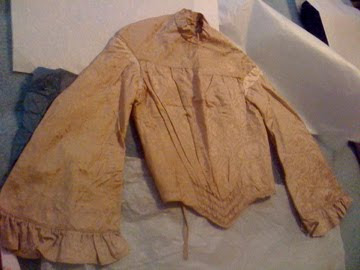
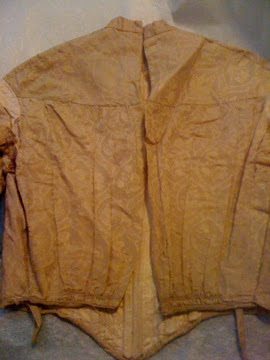
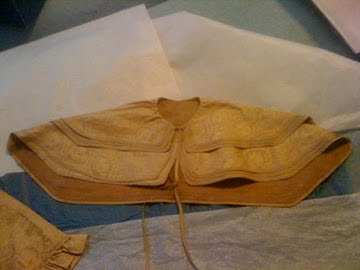
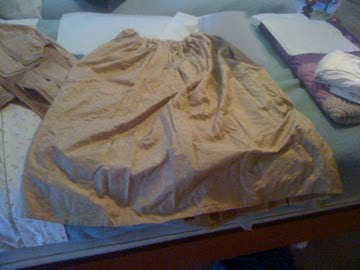
We keep things in the guest bathroom closet at my grandfather's house, apparently. Here is an mid-19th century wedding dress that I found the other weekend while I was there:

The front of the bodice.
Detail of center front:

And the back (note the cotton fabric at the shoulder on the left, presumably for ease? it wouldn't be seen--hidden under the capelet)


I'm not sure of the dating of this dress, but the point at the center front of the bodice made me think 1840s.
See this Godey's Lady Book scan.
And this 1840s Parisian bridal fashion.
And this, at the V&A!
But the bell sleeves feel later, and I suppose the high neckline and covered shoulders place it later than the 1840s too. Like, in the 1860s. See, especially, the woman on the right in the last plate in this timeline. But this waistline......

The sweet little capelet:
The skirt sure does have a lot of volume, too (it's hardly cinched):

I'm sure there's something to be learned from the construction of the skirt (is it built to be worn over a hard structure or soft petticoats?) but I didn't get that far.

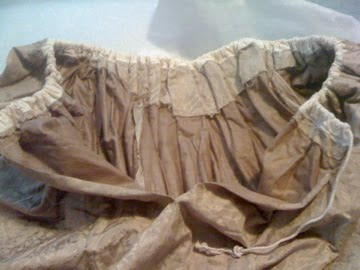
What I did see was this neat construction detail, which can also be found in the skirt I made this spring from the century before:
That little fold-over of fabric. Is it a reticence to cut? I don't imagine it would add so much volume, since unlined the silk was not terribly sturdy. I wonder if it tied in front or back? Presumably to save the fabric from wearing, the drawstring is of a different fabric, sewn to the skirt silk (I think it was cotton?).

As with everything, this is in perfect condition. Perfect! With some sweat stains, of course, and I should note that the stitching has come undone on one of the capelet trimming pieces. But that's it....

So: not Marie Anna's, but I thought I'd brag a bit. Part of the goal in reading about the meaning of objects is because I feel so lucky to have all these beautiful things that I want to share them with people in a constructive way.

Ideas?


Taborsky, Edwina. "The discursive object." In Objects of Knowledge, edited by Susan Pearce, 50-77. London: The Athalone Press, 1990.

Monday, June 28, 2010

Last Wednesday.... (or, How I Plan To Start All My Posts)

Last Wednesday I took the Metro-North, which I love so dearly, to the Bruce Museum in Greenwich to attend a lecture on American style by Jennifer Farley, assistant curator at the Museum at FIT. It was the third in a series in conjunction with their exhibition, "The Dressmaker's Art: Highlights of the Bruce Museum's Costume Collection".

This exhibition was the answer to my plea from last week: it focused on the 1820s-1920s, roughly, to which we tend to assign greater dressmaking skill. And in truth, although cutting techniques advanced and designers with genius preternatural draping skills became the superstars of the 20th century, the elaborate contraptions most of our modern generation would burn their jean cut-offs to avoid wearing are, indeed, intricate examples of dressmaking art. The piecing of Vionnet and Toledo are brilliant, and recent designers I couldn't begin to name structure fabrics into impossible, inspiring shapes, but if we are talking traditional dressmaking techniques, nothing from the twentieth century compares to that which came before.

I should mention, too, that the Museum at FIT does an excellent job of including pieces from not only the early 19th but even the 18th century, as well as from as recently as the current year. But they do successfully join the mid- to late-20th century exhibition vogue, as that seems to be where public fascination lies (thanks, Mad Men). So it makes sense that this second lecture in the series, a collaboration between the MFIT and the Bruce, would be an excellent overview of American Style from the 1930s to the 1950s.

Ms. Farley gave a great presentation, debunking fashion myths, noting the big designers but emphasizing the greater story, and chronicling the many changes that took place within those short twenty years. The other women in the audience, ninety percent of whom were old enough to have worn the styles seen in the presentation the first time around, proved my "public fascination" theory with their oohs and ahhs, exclaiming "I LOVE that, how PRETTY". They are allowed, of course, and that is the reason fashion exhibits exist at this point, but I see more and more why my predilections cannot be gratified. Many of my favored dresses are seen as restrictive and old-fashioned, where women's waists and lives are cinched into fourteen inches somewhere near the hearth, but somehow, the New Look dresses and their housewife mannequins are cooed over and collected.

Perhaps because we can still wear them? They are not precious and about to fall to pieces? They can be easily integrated into our current fashion systems? Hoop skirts and bustles would be considered rude on the subway? H & M hasn't done an 1870s line yet?

But: I suppose I can't ask for anything more than expressions of preference, as those would probably be my only reactions were I to walk through, say, the ceramics exhibits at the Met.

I took some pictures, but was eventually caught and chided, and therefore will keep them to myself. But it was nice to see some lightweight summer examples from the 1890s, since the hallmarks of the decade tend to be the heavy walking suit or new sporting fashions for riding bicycles. I wish I had been able to examine it more closely, since we have in Marie Anna's wardrobe at least one cotton example that is so thin it is see-through; I'd like to know what was worn underneath it, and wouldn't that defeat the purpose?

So: the lecture was inspiration for the 20th century section of Costume History, which I am taking this fall. And the exhibition reinforced my personal assumption that I will end up at some sort of small, regional museum.

A worthwhile trip, all around! I got to hear some really great tri-state accents, even. Let me know your thoughts if you go!

Stay tuned for some in-depth examinations of the bodices I've looked at so far. Hopefully with this trip home I can pick up some more summery items to look at.....